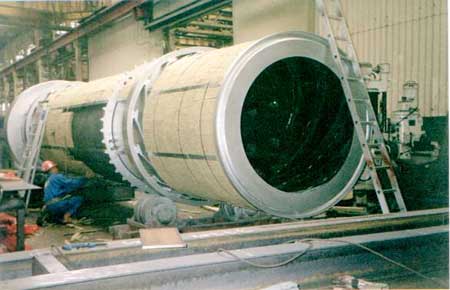
Rotary cascade dryers have the feed materials pass through a rotating cylinder together with a stream of hot gas. Internal lifters or flights elevate the feed and drop it in a curtain from the top to the bottom cascading along the length of the dryer. Flights need to be carefully designed to prevent asymmetry of the curtain. Material moves from one end of the dryer to the other by the motion of the material falling due to the angle of inclination of the drum. Some rotary dryers are double and triple pass units where each drum is nested inside the previous drum.
Rotary louvre dryers have the feed materials supported and moving over a set of louvres mounted to an external rotating drum. The hot gas is introduced into a tapered bustle below the feed ring. The air passes through the louvres and then the product before being exhausted from the dryer. The rotation of the drum causes the material to roll and mix providing intimate contact with the drying gas. Material moves from one end of the dryer to the other by the motion of rolling, some fluidization and due to the angle of inclination of the drum.
Automatic and continuous. Vibrators, screw feeders, rotary airlocks, double flap valves, gravity chutes
Powders, granules, non friable agglomerates, large solid particles. Low to high feed rates
Steam, electrical, coal, liquid fuels, or gas
Mostly Direct. Flow is co-current or countercurrent for cascade dryers. Flow is a combination of through the bed, cross, co-current or countercurrent for rotary louvre. Residence time Controllable. Residence time can be altered by varying the speed of rotation of the drum and the drum angle. Fill can be varied. Fills are typically between 7% and 25% of the cross sectional area of the drum.
Normally induced. Systems can have combustion, forced and induced draft fans for operation.
Cyclones, bag houses, scrubbers, Electrostatic precipitators. Systems require dust collection.
PLC, infrequently solid state controllers. System controls on discharge temperature. Can modulate energy and feed.